By: Nacho (GOI – Argentina)
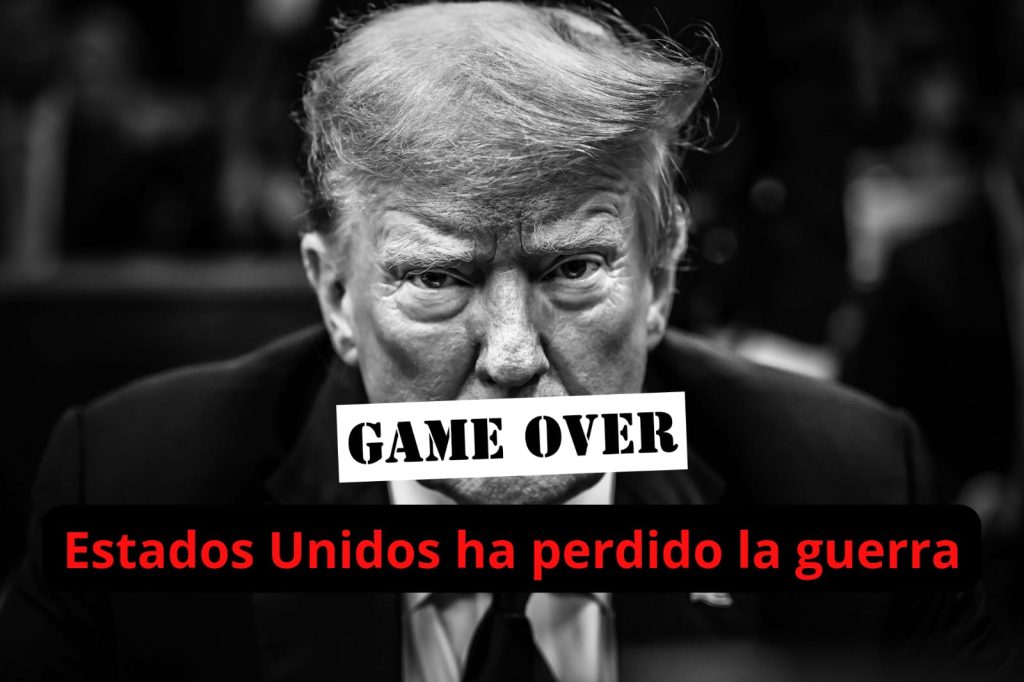
“President Trump lost this war.
New York Times, June 16, 2026.
Finally, after a long “truce,” Trump signed a Memorandum of Understanding with Iran to end the war. This comes after more than 90 days of intense fighting on Iranian territory and a long truce, repeatedly sabotaged by Israel’s invasion and attacks on Lebanon, and even by US attacks on Iranian targets. The 14 points released as part of the agreement speak for themselves: none of the goals identified by Trump and Netanyahu are included. There has been no regime change, no removal of Iranian enriched uranium, no dismantling of long-range missiles, and in practice, Iran’s control over the Strait of Hormuz is recognized. On the other hand, the agreement includes an end to Israel’s attacks on Lebanon, the return of blocked funds to Iran, and even payments as compensation for the damage suffered. A complete defeat, not only for Trump, but also for US imperialism.
Trump on his knees
The war against Iran has been defined by numerous military and political experts as an irresponsible adventure by Trump. In short, a war that is impossible to win. For our part, in recent articles, we have indicated that, contrary to what the vast majority of the world left claims, we believe that imperialism can (and must) be defeated. Reality showed that this was, in fact, the case.
It is important to remember that the U.S. offensive, fueled by Zionist aggression and genocide in Gaza, was initiated by Trump with the expectation of controlling Iranian resources and, if necessary, achieving a shift to a pro-imperialist regime. To this end, imperialism exploited the figure of the “son of the Shah” (the king deposed by the Islamic Revolution in 1979), who appeared on television channels and at political events in the West, promising to hand over Iran’s natural resources and sovereignty to the United States. A similar case to Corina Machado’s and Juan Guaidó’s in Venezuela. All projects failed. Also several Mossad (Israeli intelligence service) operations to infiltrate weapons to opposition groups, targeted assassinations and even attempts to promote Kurdish incursions into Iranian territory were covered up.
As we stated in March, Trump and the Zionist lobby started this war to control Iran’s natural resources (mainly oil) and as a way to respond to the “home front.” It is important to remember that the domestic situation in the United States is marked by a deep political and economic crisis, a rising cost of living, attacks on immigrants and a labor crisis, all on the eve of this year’s midterm elections. Meanwhile, Israel is at its worst, suffering global condemnation for the genocide against the Palestinians, and Netanyahu is under threat of impeachment and faces an arrest warrant from the International Criminal Court.
The masses spoken
Trump bet everything on war. It involved at least three Task Forces, each with its own aircraft carriers, frigates, and destroyers, in addition to the Air Force and Special Forces. This mobilization has not been seen for decades. Encouraged by Operation Total Resolve, which resulted in Maduro’s capture and the capitulation of Venezuela, Trump baptized this new adventure “Epic Fury.” This “epic” operation quickly turned into an American nightmare. History itself has already taught, in great detail, the result of war when imperialism faces an enemy that fights to the end and the masses, capable of imposing their will on their own territory. Vietnam is a forceful lesson that Trump and the lobby that supported him believed would never be repeated.
Once engaged in a full-scale aggression against Iran, with the participation of its regional allies, reality showed that there was only one way to defeat a nation that had spent decades amassing missiles and entrenching itself in the mountains, preparing to resist: a ground invasion.
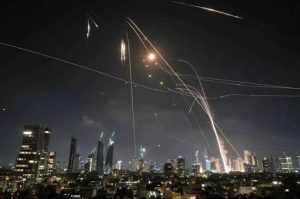
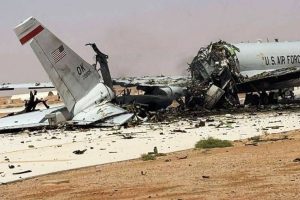
At that time, dozens of U.S. drones and several U.S. fighter jets were shot down, more than 14 U.S. bases in the region were destroyed or badly damaged, Israel was suffering daily bombardments from missiles and drones, and its ammunition to defend itself from Iranian attacks was running out.
Iran resisted far beyond what was anticipated and now counterattacked the United States and Israel. Trump had only two options left: enter by land or withdraw. For more than two weeks, all kinds of rumors circulated in the international media. That Trump would take Kharg Island, where Iran’s oil production is concentrated. That the Mossad, with the Kurds, would enter from the north, or that a special operation would remove the uranium at night, without anyone noticing. It was all part of a media spectacle to gain time. The reality is that the United States was not in a position to launch a ground attack. But why? The problem for the world’s largest army was not a lack of weapons or troops. The popular masses in the US simply demanded to step on the brakes.
No Kings Dayagreed, on March 28, brought together a series of protests and demonstrations that had been intensifying against the Trump administration. The protests against the rising cost of living, health care cuts, and attacks on immigrants by the ICE paramilitary force linked directly to the economic waste of the war against Iran. The U.S. spent $30 billion on ammunition alone, and the total loss is around $200 billion. For the world economy, the cost is much higher, as it has caused inflation in dollars due to the increase in the price of crude oil (which reached US$ 126 a barrel, when the average is around US$ 80).
More than 8 million people took to the streets in 3,300 coordinated events in the 50 states, chanting slogans against the Trump administration. The protests also reverberated in major European cities. Trump’s approval rating plummeted, reaching 59% rejection. According to the media itself, it was the largest protest march in the history of the United States. The Democratic Party tried to channel discontent in its favor and organized several Day Without Kings events, but the focus was on rejecting Trump instead of supporting Democratic candidates. The masses had demonstrated. The American people rejected war and were not willing to be sent to die in Iran, as had already happened in Vietnam, Afghanistan and Iraq.
Does the agreement guarantee peace?
The 14-point memorandum, signed by Trump and the Iranian regime, includes, among other things, a 60-day period to evaluate its implementation and is clearly a defeat for both the United States and Israel. In fact, this point has been the most controversial since the signing of the agreement. Trump himself criticized Netanyahu for the bombings in Lebanon, saying he “went too far.” It was something that mattered to him only now, as it could damage his reputation even more. When Zionism devastated Gaza, it did not consider it problematic.
Meanwhile, both Israeli National Security Minister Ben Gvir and Finance Minister Bezalel Smotrich, far-right Zionists known for filming torture of detainees, have come forward to criticize Trump and the deal and justify the invasion of Lebanon. It was J.D. Vance, the U.S. vice president, who stepped in to “put them in their proper place,” reminding them that the United States is Israel’s only remaining ally in the world and that they should not push their luck.
Beyond the “diplomatic” back-and-forth, these clashes reveal the fragility of the agreement and increase doubts about its longevity. In fact, one of the clauses has already been violated by Trump, who has threatened new attacks if Iran does not comply with the agreement, and Israel itself bombed southern Lebanon again after it was signed. The resumption of hostilities cannot be ruled out, either by pressure or by necessity of any of the parties, or in the event of changes in the political scenario. The reality is that as long as there is an imperialist military enclave with a Zionist agenda in the Middle East, the war will not end. In addition, it serves as a justification for criminal and totalitarian regimes that massacre and repress their own peoples, as happened in Syria and as is currently happening in Iran itself.
As a “pearl” of the agreement, and seeking to involve them, Trump especially thanked Putin (who is suffering fierce attacks from the Ukrainian resistance) and Xi Jinping for remaining neutral during the war. What he really appreciates is that at the moment of America’s greatest vulnerability, neither Russia nor China have crossed their boundaries or opened a new front by taking advantage of the situation. This reveals that, far from there being, at least openly, a “confrontation between blocks” or “poles”, the various world powers are working to contain the masses and maintain control in their spheres of influence.
The Iranian dilemma
The Iranian masses who rose up against the totalitarian regime of the ayatollahs in January and resisted the brutal repression were also those who understood, in the face of imperialist aggression, that the defeat of the United States was necessary to continue the struggle against the regime. They heroically resisted the American bombings and attacks. They risked their lives in the fighting and lost thousands of loved ones. Now they face another major challenge. The regime will try to use its victory in this war, as well as the economic compensation it receives, to strengthen itself and suppress all opposition. On the other hand, the masses who defended their homeland against the invader must now turn their weapons against the regime that seizes their resources and represses their freedom. The Iranian masses now face an existential dilemma. It will only be possible to achieve better living conditions by overthrowing the regime and building a workers’ and people’s government.
In turn, peace in the Middle East can only come through imperialist expulsion from the region and the fall of totalitarian regimes at the hands of their own peoples, as part of a worldwide struggle for a society that, unlike capitalism, does not depend on exploitation and oppression to exist.
A socialist world is possible
As history demonstrates and the war against Iran proves once again, imperialist defeat always has consequences. A defeat of the United States and Israel, or their weakening (and of their war policies), represents a breath of fresh air for the ongoing struggles. All the peoples who resist the colonialist offensive of the United States and its allies emerge strengthened.
The “almighty” Trump was defeated by a country with a GDP 108 times lesser and a population 4 times smaller. Imperialism has been contained by the heroic Iranian masses, who refuse to surrender, and by the American masses, who have mobilized en masse to face the war in their own country. How can we not be optimistic? It is undoubtedly a great day for revolutionaries and fighters around the world. A great opportunity opens up again for the mission of the peoples of the Middle East: the destruction of the Zionist enclave that is the State of Israel, responsible for the genocide against the Palestinian people and for attacking and invading all neighboring nations, spreading terror in the name of imperialism.
On the other hand, without going any further, and although it may seem strange to some, the Bolivian resistance that confronts the government of Rodrigo Paz with strikes, blockades and workers’ and people’s self-defense is also favored, since it confronts not only his government, but also the pro-imperialist policy of plunder openly promoted by the United States in the region.
The American defeat demonstrates to the world that neither aircraft carriers, nor state-of-the-art fighter jets, nor missiles and drones, nor nuclear bombs are immune to the class struggle. That no matter how advanced the technology, artificial intelligence and intelligence services, the final word will belong to the class war between businessmen and the people, bosses and workers, the bourgeoisie and the working class. Events like this leave speechless the main currents of the world left, increasingly reformist, who build their parties in the comfort of democracy, while forgetting that it is, in fact, a democracy of the “rich”, or, as we revolutionaries call it, a bourgeois democracy, the democracy of our class enemies. For those who dedicate pages and speeches to convincing the workers and the masses that the only real way out is to “know how to vote” in the next elections or to support left-wing candidates, reality shows, once again, that it is far from their preaching: austerity governments can fall and imperialism can be defeated.
We are witnessing, once again, a reality that repeats itself throughout history. What seems impossible often happens, and in this case, it benefits the world’s workers. This reopens a perspective that, in the mouths of capitalist spokesmen, seems impossible: if the “master” of the world, who concentrates all economic and military power, can be defeated, then a different world is not only necessary, but also possible.
But in order for the working masses to organize and walk the path towards a world socialist society, it is necessary to build a revolutionary leadership. What is needed is a workers’ and revolutionary party, with a programme which will lead to the seizure of power by means of insurrection and which will destroy all illusions about the capitalist democracy in which we live. It is with this project that we seek to contribute, from our small space, together with comrades from different countries, to the construction of a revolutionary alternative for the workers.
Below, we present the 14 points that make up the signed Memorandum of Understanding:
The United States of America and the Islamic Republic of Iran have jointly agreed in good faith (at a date yet to be determined, according to the official) to the following:
Paragraph 1 – The United States of America and the Islamic Republic of Iran, as well as their allies in the current war, by signing this Memorandum of Understanding (MoU), declare the immediate and permanent cessation of military operations on all fronts, including Lebanon, and undertake, from this moment on, not to initiate any war or any military operation with each other, to refrain from the threat or use of force against each other and to guarantee the territorial integrity and sovereignty of Lebanon. The final agreement will confirm the permanent termination of the war on all fronts, including Lebanon, as well as the other provisions of this paragraph.
Paragraph 2 – The United States of America and the Islamic Republic of Iran undertake to respect each other’s sovereignty and territorial integrity and to refrain from interfering in the internal affairs of the other party.
Paragraph 3 – The United States of America and the Islamic Republic of Iran undertake to negotiate and reach a definitive agreement within a maximum period of 60 days, extendable by mutual consent.
Paragraph 4 – Immediately after the signing of this MoU, the United States of America shall begin to lift its naval blockade and any disturbance or obstacle imposed on the Islamic Republic of Iran, and shall completely end the naval blockade within 30 days. During this period, the traffic of vessels will be proportional to the volume of movement existing before the war that will be reestablished by the Islamic Republic of Iran. The United States of America also undertake to withdraw its forces from the vicinity of the Islamic Republic of Iran within 30 days of the signing of the final agreement.
Paragraph 5 – After the signing of this MoU, the Islamic Republic of Iran shall adopt measures, using all possible efforts, to ensure the safe passage of commercial ships, free of charge and only for 60 days, from the Persian Gulf to the Sea of Oman and vice versa. Commercial ship traffic will be resumed immediately and — considering the need to remove technical and military obstacles, as well as carry out demining operations by the Islamic Republic of Iran — will be fully restored within 30 days. The Islamic Republic of Iran will start a dialogue with the Sultanate of Oman to define the future administration and maritime services in the Strait of Hormuz, in consultation with the other coastal states of the Persian Gulf, in accordance with applicable international law and the sovereign rights of the coastal states of the Strait of Hormuz.
Paragraph 6 – The United States of America undertakes, together with its regional partners, to draw up a definitive and mutually agreed upon plan, worth at least 300 billion dollars, for the reconstruction and economic development of the Islamic Republic of Iran. The mechanism for implementing this plan will be defined as part of a final agreement within 60 days. The United States of America will grant all necessary licenses, exemptions and authorizations for the relevant financial transactions.
Paragraph 7 – The United States of America undertake to end all types of sanctions against the Islamic Republic of Iran, including the resolutions of the United Nations Security Council, the resolutions of the Board of Governors of the International Atomic Energy Agency (IAEA), and all unilateral sanctions of the United States, both primary and secondary, according to a schedule to be agreed upon as part of the final agreement. The Islamic Republic of Iran and the United States of America recognize the critical importance of the issue of lifting the above-mentioned sanctions and express their intention to immediately address these issues in the negotiations in order to reach a mutual agreement on them.
Paragraph 8 – The Islamic Republic of Iran reaffirms that it will not acquire or develop nuclear weapons. The United States of America and the Islamic Republic of Iran have agreed to resolve the issue of the disposal of enriched stored material through a mutually agreed upon mechanism in accordance with the schedule mentioned in Paragraph 7, the minimum methodology being on-site dilution under the supervision of the International Atomic Energy Agency (IAEA). Both sides also agreed to discuss the issue of enrichment and other issues related to the nuclear needs of the Islamic Republic of Iran that may be mutually agreed upon, based on a satisfactory framework set out in the final agreement. The final agreement shall confirm the provisions of this paragraph. The United States of America and the Islamic Republic of Iran recognize the fundamental importance of the above-mentioned nuclear issues and express their intention to immediately address these issues in the negotiations in order to reach an agreement.
Paragraph 9 – Pending the final agreement, the United States of America and the Islamic Republic of Iran agree to maintain the status quo. The Islamic Republic of Iran will maintain the current status quo of its nuclear program, and the United States of America will not impose new sanctions or deploy additional forces in the region.
Paragraph 10 – The United States of America undertake that, immediately upon the execution of this Memorandum of Understanding and until the completion of the sanctions lifting process, the U.S. Department of the Treasury will issue waivers for the export of Iranian crude oil, petroleum products, and derivatives, as well as for all associated services, including banking transactions, insurance, transportation and others.
Paragraph 11 – The United States of America undertake to make fully available for use the funds and assets frozen or subject to restrictions of the Islamic Republic of Iran following the implementation of this Memorandum of Understanding. The United States of America and the Islamic Republic of Iran will define in commom agreement with the procedures related to the release of these funds during the negotiations. These funds — whether held in the original account or transferred — will be fully available for payment to any final beneficiary designated by the Central Bank of the Islamic Republic of Iran. The United States of America undertake to issue all necessary licenses and authorizations for this purpose.
Paragraph 12 – The United States of America and the Islamic Republic of Iran agree that an executive mechanism will be established to oversee the proper implementation of this Memorandum of Understanding and the future fulfillment of the final agreement.
Paragraph 13 – Following the signing of this Memorandum of Understanding – and subject to the commencement of the implementation of paragraphs 1, 4, 5, 10 and 11, as well as the continued application of these measures – the United States of America and the Islamic Republic of Iran shall begin negotiations on the final agreement, exclusively with respect to the remaining paragraphs.
Paragraph 14 – The final agreement shall be ratified by means of a binding resolution of the United Nations Security Council.