By: Manuel Nuñez – MIT (Chile)
Introduction: When Youth Bursts Onto the Stage of History
The year 2006 marked a turning point in Chile’s recent history. The “Penguin Revolution” was not merely another student protest, but the emergence of a generation—primarily the sons and daughters of the working class—that challenged not only the neoliberal education system, but also the structural limits of the model inherited from the dictatorship and managed throughout the democratic transition.
At a time when young people were widely portrayed as apathetic, high school students led the largest social movement since the return to democracy. What began as demands concerning student transportation passes, school infrastructure, and the cost of the PSU (University Selection Test) quickly evolved into a broader challenge to the existing social order. This cycle formed part of a wider recomposition of the class struggle in Chile. The Penguin Revolution emerged as a historical opening, not as a conclusion.
Against Market-Driven Education
The roots of the rebellion lay in the structure of the education system consolidated at the end of Pinochet’s dictatorship (1973–1990) through the Constitutional Organic Law on Education (LOCE), enacted in March 1990—before Pinochet handed over power—as a legal mechanism designed to preserve the model regardless of the formal change in political regime. Municipalization, voucher-based funding, and the opening of education to profit were enshrined in law.
The result was a profoundly unequal system in which education ceased to be a social right and instead became a commodity, serving as a mechanism for reproducing inequality. During the democratic transition, this system was not dismantled but rather deepened. The governments of the Concertación consolidated market logic, widening the gap between public and private education.
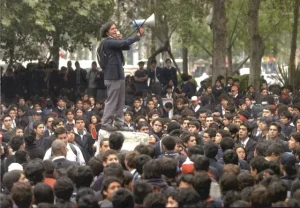
The struggle was led by the Coordinating Assembly of Secondary Students (ACES), an organization that did not emerge in 2006 but rather as a split from FESES, which was controlled by the Communist Party and subordinated to the Concertación. FESES was criticized for being a bureaucratic structure disconnected from its grassroots. ACES first gained national prominence during the “Mochilazo” of 2001, when thousands of students brought Santiago to a standstill demanding free public transportation for students. Forged through open assemblies, elected spokespersons, and recallable delegates—with power residing in the rank and file rather than in permanent leaders—this organizational model would shake the country five years later.
A new generation was beginning to break with traditional forms of mediation, including established political parties and previous student leaderships.
2006: From Immediate Demands to Challenging the System
The movement began with concrete demands: the cost of the PSU, restrictions on student transportation, and the deteriorating conditions of public schools. However, these demands rapidly evolved into a structural critique. The call for the repeal of the LOCE encapsulated this political leap: the problem was no longer simply the administration of the system, but its very architecture.
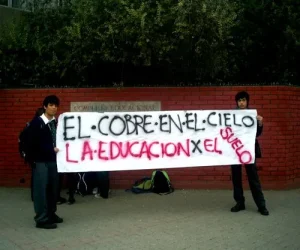
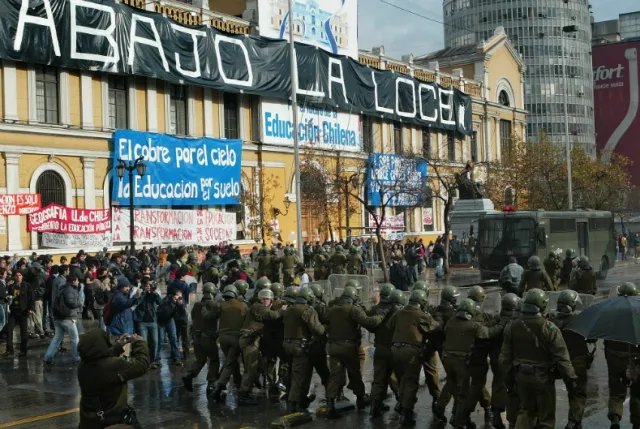
The slogan, “Copper prices are soaring while education lies on the ground,” became central. It was not merely symbolic, but a political synthesis of the country’s development model: the contradiction between Chile’s immense wealth and the deterioration of fundamental social rights. Here emerged the idea that education cannot be separated from the way social wealth is distributed.
Organization, Internal Tensions, and Direct Democracy
ACES operated through assemblies, mandated and recallable spokespersons, and enjoyed strong grassroots legitimacy. This organizational model reflected a broader political conception: grassroots democracy, distrust of traditional representation, and the pursuit of direct control over collective decision-making.
Nevertheless, the process was marked by internal tensions, institutional pressures, and political disputes. Although no political party achieved hegemony within the movement, conflicts with bureaucratic party structures were constant. The challenge was structural: sustaining a horizontal organization under pressure from both the state and the media, without a political leadership capable of projecting the movement beyond the immediate struggle.
Mass Mobilization, Repression, and the State’s Response
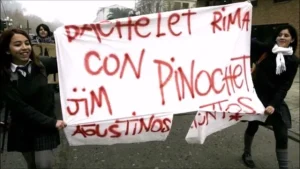
The movement reached an unprecedented scale. The national strike of May 30, 2006 mobilized between 700,000 and 800,000 students, making it the largest student mobilization of the post-dictatorship period. By the end of May, more than 600 schools across the country had been occupied or were actively mobilized.
The state’s response was equally significant: approximately 730 people were arrested in a single day. Political management of the crisis fell to the Ministry of the Interior, led by Belisario Velasco, who coordinated a containment strategy that combined repression, institutional pressure, and political negotiation. The objective was to wear down the movement, isolate its most militant sectors, and redirect the conflict into institutional channels.
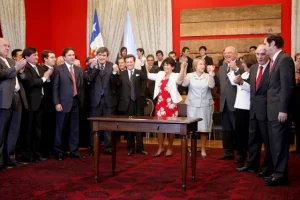
Michelle Bachelet’s government offered partial concessions: free student transportation passes, expanded school meal programs, some improvements to school infrastructure, and free PSU registration for vulnerable sectors. These measures did not resolve the structural conflict but sought to divide the movement’s social base. The crisis also led to changes within the Ministry of Education, including the resignation of Minister Martín Zilic. Ultimately, the government’s strategy culminated in the creation of the Presidential Advisory Council, which transferred the conflict into controlled institutional spaces, contributing to the movement’s demobilization.
Assessment: Achievements, Limits, and Lessons
The movement succeeded in placing education at the center of Chile’s structural problems. Although insufficient, the gains achieved were real and represented advances that had not previously existed.
No one had anticipated such a development. The surprise was widespread. The movement had a profound impact on political parties, the government, intellectuals, the media, and even sectors of the left.
The LOCE was eventually replaced by the General Education Law (LGE). However, this reform did not alter the system’s underlying structure, leaving its market-oriented logic intact.
The movement eventually experienced exhaustion, fragmentation, and the partial institutionalization of some of its leaders. The struggle against the bureaucracies of the traditional parties—the Communist Party (PC), the Socialist Party (PS), the Concertación, and sectors of the far left—which sought to intervene in and neutralize the movement, remained constant. Some leaders, such as César Valenzuela and Karina Delfino, both members of the Socialist Party, were removed by the grassroots after becoming absorbed into the very system they had once opposed. Leon Trotsky’s warning that “bureaucracy arises when representatives cease to be controlled by the rank and file” (1936) proved true in practice. What happened to the student movement was not an accident; it was the consequence of lacking an independent political organization.
However, the assembly-based method alone is not enough. Horizontalism without political leadership creates fertile ground for opportunists to negotiate with the state. The experience of 2006 teaches that spontaneity must be complemented by building a working-class party with a program based on political independence, anti-capitalism, and socialism.
The movement also faced an objective limitation: its weak connection with the organized working class. This disconnection made its isolation easier. No sectoral struggle can triumph on its own.
In this context, the slogan “Copper in the sky, education on the ground” remains fully relevant. It was not merely a denunciation, but a strategic insight into the relationship between national wealth and social inequality. There can be no dignified education without questioning how wealth is produced and distributed. This remains a fundamental slogan for advancing today’s struggles.
The Penguins of 2006 demonstrated that the youth of the working class can challenge power when they organize democratically through assemblies and recallable mandates. These organizational forms belong to a much longer tradition of popular self-organization in Chile: workers’ mutual aid societies, Recabarren, Clotario Blest, and the industrial cordons of the Popular Unity period. The experience of 2006 was not an isolated episode but the beginning of a cycle that continued in 2011 and deepened during the October 2019 uprising. We are a people with a recent history of great struggles.
Conclusion: Memory, Historical Task, and the Current Struggle
Two decades after the Penguin Revolution, its legacy remains unfinished. Young people—the sons and daughters of workers—demonstrated the transition from the classroom to the class struggle.
Today, the political dispute cannot be reduced to a figure such as Kast. The struggle against the right is necessary, but it is not sufficient. It is a trap set by the bourgeoisie to discipline social movements. The Concertación, the Communist Party, the Broad Front, and progressive governments have all administered the same model of inequality for more than three decades. They did not transform its structural foundations; they merely deepened them. Therefore, the struggle is not only against the right. It is against the capitalist system as a whole and against those who administer it.
Both in the student movement and in the world of work, the task remains the same: to unite fragmented struggles, rebuild organization from the grassroots, and advance toward an independent political alternative for the working class.
We must recover the assembly-based methods of ACES—but also go beyond them. We must build organization, a political program, and a party. That is the task the Penguins left us. Twenty years after 2006, their slogan remains as relevant as ever: Education is not for sale—it must be defended. And the only way to defend it is by building a revolutionary organization of the working class.