From La Paz, Camila (Chile) and Altino Prazeres (Brazil). CIR Delegation in Bolivia.
Its Friday, June 19, Wednesday afternoon, June 17, closed with the news that dialogue or negotiation was taking place between President Rodrigo Paz Pereira, the leaders of the Bolivian Workers’ Central (COB) and peasant organizations.
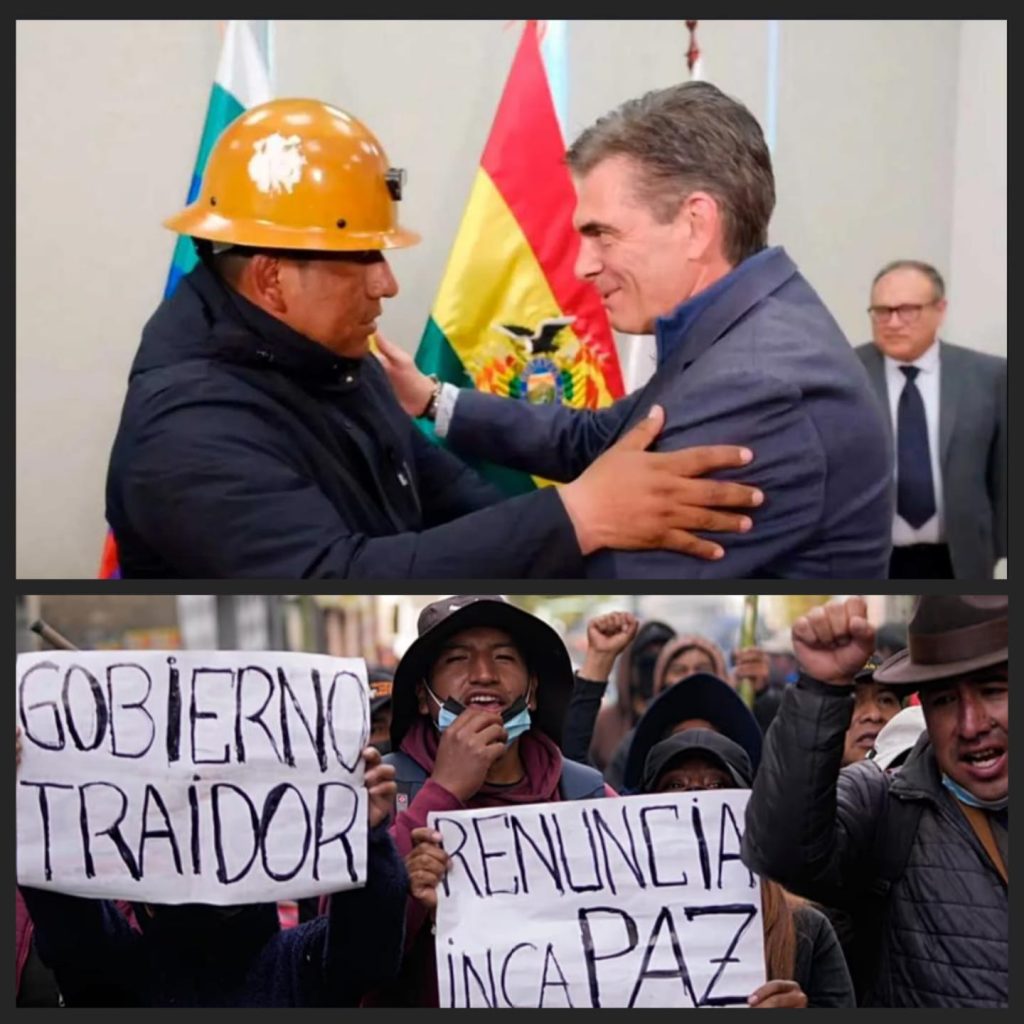
The executive secretary of the COB, Mario Argollo, left the meeting with Rodrigo Paz, saying that they condition the dialogue on the cessation of the persecution of activists and freedom of political prisoners produced after the protests that broke out in Bolivia 50 days ago, however, today they are already reviewing “case by case”.
On the other hand, up until Wednesday, June 17, when we visited a blockade in District 8 of El Alto, a sector of the peasant bases told us that there is nothing to dialogue with this government, that they demand its resignation, because there is a lot of humiliation and discrimination it has imposed on them: they treat the indigenous women as dirty, they spit in their faces, they have criminalized them as vandals and drug traffickers, even as coup plotters, they have treated them as Evo Morales’ beasts and sheep or that they are all evistas, all totally false.
The truth is that not all peasants and sectors in struggle are evistas and much less financed by Evo Morales, nor are they narco-terrorist vandals, they are only men and women workers and today are fighting for their dignity in a scenario of economic crisis. Like the majority of the working population, they fought against the rise in fuel prices, for the repair of junk gasoline that affected more than 70 thousand vehicles and machinery – not yet repaired – and for the elimination of decrees that Rodrigo Paz has promulgated between last year and now.
The demands for the withdrawal of these decrees are felt more by the indigenous people, since they promoted the end of the small peasant plot (unseizable) and eliminated the need for indigenous consultation, promoting mining businesses without control. These decrees also open the door to privatize YPFB (Yacimientos Petrolíferos Fiscales Bolivianos), the Bolivian state-owned company in charge of the entire hydrocarbon chain, and also concentrate decision-making power in the executive.
However, this just struggle is being stifled and attacked by the polarization that the bourgeoisie seeks to impose: they blame the blockaders for food shortages and country situation, when the great problems started before. Today in La Paz there are sectors of commerce workers or others, who replicate the bourgeois discourse that indigenous people and even the COB with its leaders are vandals or maximalists, or they also echo Rodrigo Paz’s discourse that miners wages cannot be raised, as demanded, because that will affect with higher inflation and would deepen the problem of labor informality in Bolivia (in La Paz you see many self-employed merchants, even Rodrigo Paz said that labor informality reached 80% of the population).
Thus, Rodrigo Paz’s tactic of taking this struggle to the point of attrition and then dividing in order to govern, has borne fruit, thanks to the collaboration of the COB leaders. Several days ago, the transport workers had already dropped out of the struggle because Rodrigo Paz negotiated with them separately, and COB leadership did not organize the workers’ and miners’ bases to go out to protest.
The leadership of the COB refused the demands of sectors of miners, such as those of Huanuni, who called for radicalizing the measures by calling for a mining march to La Paz, unfortunately after that call the leaders of the miners of Huanuni began to negotiate with Rodrigo Paz shortly before the COB leadership. Thus, the leaders allowed the road blockades to continue as the only measure of struggle for 50 days, wearing themselves out and having to face the discontent of a large part of the population of the cities that suffered the consequences. Worse still, the COB leadership postponed on more than 3 occasions the expanded meeting it had called for, to draw up a plan of struggle and during those days the leader of the COB, Mario Argollo, was conspicuous by his absence. He reappeared on Tuesday, June 16, to say that he was about to dialogue with Rodrigo Paz to “pacify Bolivia.”
On Tuesday, June 16, a statement had already been issued by the Departmental Federation of Peasant Workers of La Paz “TUPAC KATARI”, in which they described the conditions for a rapprochement with the government, among which the following stood out: the reparation of the damage caused by junk gasoline; the freezing of interest on the population’s loans; the repeal of decrees promoted by Rodrigo Paz; that political persecution cease and that trade union immunity be respected, in addition to releasing those arrested after the protests and reparations for those murdered; and finally the repeal of the State of Emergency Law recently enacted by Paz. Then, on Wednesday, June 17, the COB statement came out, with almost the same content, only emphasizing the freedom of political prisoners, but also calling on the government to fulfill its program and its electoral promises.
In these two declarations, the directives have a common agreement: That Rodrigo Paz continues to govern, he is even called to fulfill his program. Dialogue is not negative in itself, only that this dialogue is implying putting aside the main demand of the mobilized people: the resignation of the president.
In this context, mobilizations and blockades are on the decline, a few days ago there were about 100 blockades and today the media report just over 40. With this, some of the sectors that continue to block call for radicalizing the protest, but they run the risk of being isolated. The process is not yet completely closed, but if Paz continues to govern it will be the main responsibility of the leadership of the COB, which once again left its bases abandoned. They will be responsible for the government and the bourgeoisie continuing the path of privatizing natural resources such as lithium and hydrocarbons, to hand them over to imperialism as was being discussed with the visit of Major General Jim Ryan, commander of the U.S. Southern Command Army at the end of April.
It is no coincidence that the words of Rodrigo Paz’s government in this crisis are only an echo of what Marco Rubio (the Secretary of State of the United States, a member of the Republican Party) said, slandering the demonstrators as narco-terrorists. Despite these definitions, Rodrigo Paz was afraid of increasing repression and bet on attrition to close the blockades.
The COB leadership did not carry out the fight for Rodrigo Paz to fall, because doing so would open a crisis again and the debate of who governs in Bolivia, the vice president is not an alternative for stability, and the COB leadership fears that the process brewing from below will get out of hand.
History repeats itself, today the leadership of the COB, as always, refuses to resolve the dual power with the workers’ and peasants’ power, through the Central itself. They always bet on some electoral solution. This is what they did during the revolutionary process of 2003-2005, betting on the elections that brought Evo Morales to the presidency. With Evo at the head, the country never broke with Yankee imperialism, only that its business was also with the Chinese and Russian bourgeoisie. With Evo, capitalism continued in Bolivia, the overexploitation of gas and dependence on mono-export of raw materials led the country to crisis. Today Rodrigo Paz wants to deepen that plan but now hand in hand, centrally, with Yankee imperialism.
It is the job of the Bolivian working class and peasants to demand that the leaders of the COB put their revolutionary and pro-worker discourse into practice. Mario Argollo said that if Rodrigo Paz did not comply “he would revolutionize Bolivia,” but in fact he has not organized the mining bases. If the leaders do not move from discourse to practice, it will be the task of the Bolivian working class and peasants to replace them and recover the glorious Bolivian Workers’ Central, putting other leaders who are at the height of their struggles, under democratic mechanisms of functioning.
Thus, it will be in a better position to advance, as the Pulacayo Theses propose, in the struggle for workers’ power, building a government of workers, peasants and indigenous people that breaks with the bourgeoisie and imperialism in pursuit of a socialist, fraternal and solidary Federation of Latin American countries.