By Eduardo Aguayo. Insurgencia. Paraguay
The Bolivian working masses have re-entered one more chapter of those historical crossroads that define the destiny of the exploited and oppressed peoples. Six months after taking power, the right-wing government of Rodrigo Paz Pereira falters under the weight of an insurrectionary upsurge that paralyzes the country’s arteries with more than fifty road blockades and mass mobilizations that permanently besiege government headquarters in La Paz.
The international bourgeoisie, U.S. imperialism and the OAS, with special support from governments that signed the alliance of subordination with Trump in the so-called “Shield of the Americas” such as Javier Milei, José Kast or Santiago Peña, now including “progressives” such as Lula, are desperately closing ranks to defend the “democratic order” so that popular irruption does not spread throughout the continent threatening their capitalist interests as a whole; while the central demand that unifies the exploited roars with unbreakable force throughout the country: Immediate resignation of Rodrigo Paz Pereira!
To understand the dynamics of the May 2026 actions, we must start from what is happening on the battlefield; The masses are giving everything that their current level of organization allows, and in accordance with the political orientation of their current leaderships, in a process of revolutionary ascent that entails: a majority break with the government, independent organization, boycott, sabotage, selfdefense and offensive on bourgeois private property, and situations of dual power in regions it controls. However, all the heroism of the Bolivian people can dissipate if they do not advance beyond their reformist and trade union leaderships, which are deeply adapted to the functioning logic of the bourgeois state.
For the Bolivian vanguard to be able to sweep away bourgeois-democratic illusions and advance towards class independence and conquer a workers’, socialist and effectively revolutionary government, it is necessary to build a program that has this objective as its strategic goal. Without a revolutionary party acting in the process, in the best of cases, a revolution, deformed from the beginning by its leadership, could be born, as was the Cuban one, hence the most important task is to build such an organization in the heat of the struggle with the most advanced members of the working class and mass movement.
The end of the Movement Towards Socialism (MAS) cycle in the 2025 elections confirmed the verdict that Trotskyism has tirelessly pointed out: when a revolution is stopped by the actions of class collaboration governments, it inevitably opens the path to the reaction of the right.
A struggle that is part of the framework of resistance to imperialist policies
Paz Pereira, as a good lackey of imperialism, is complying with an agenda of cuts and attacks against working people, in the framework of increasing exploitation and plundering of their resources by deepening the restructuring of the Bolivian productive matrix, thus satisfying Trump’s U.S. policy that implies redoubling the looting, recolonization, dependency and repression as Milei, Kast, Lula or Peña do.
The struggle of the Bolivian people is the same as that of all the peoples of the region, resistance to plans of misery and hunger, in the framework of the worsening capitalist system crisis they want to make us pay. More than ever we must raise the anti-imperialist flags strongly, the struggle against Paz Pereira is not only of interest to the Bolivian working class, a victory of the brave Bolivian working people will mean a victory for all the peoples of the region and will demonstrate that it is possible to defeat the imperialist agenda applied by its junior partners, the Latin American bourgeoisies whom we must defeat.
The bankruptcy of the MAS and the emergence of the adjuster Paz Pereira
For twenty years, the false “Socialism of the 21st Century” of Evo Morales and Luis Arce served as a buffer for the formidable revolutionary energy displayed by the working class, peasants and urban poor in the 2003-2005 struggles. The MAS never set out to destroy the bourgeois state or the foundations of Bolivian underdeveloped capitalism; on the contrary, it guaranteed transnationals’ mining and petroleum profits, expanded banks privileges and systematically capitulated to the landowning and agroindustrial oligarchy of the East; when people reacted, they did not hesitate to brutally repress, within the framework of satisfying the appetites of national and transnational bourgeois order.
When the hydrocarbon bonanza ran out, the Arce government unloaded the crisis on the shoulders of the people. The subsequent and infamous electoral dispute between the “evista” and “arcista” factions – a fight over bureaucratic handouts and judicial shields – temporarily fragmented and demoralized workers’ organizations, paving the way for the electoral return of open reaction, embodied in Rodrigo Paz Pereira.
Since taking office in November 2025, Paz Pereira’s regime has only confirmed its character as a direct agent of agro-industrial capital and imperialism. After populating his cabinet with businessmen from the primary-export sector, the government began by eliminating taxes on large fortunes and withdrawing subsidies for essential foods such as flour. He then proceeded to end fuel subsidies, which confronted him with a huge mobilization in the January actions known as “the gasolinazo”, which made the government retreat, but didn’t manage to advance further due to the actions of the COB leadership that ended mobilizations without having achieved anything concrete, only promises. These anti-popular measures, added to the suffocating shortage of foreign currency and the endemic crisis of poor-quality fuels, pulverized workers purchasing power, plunging the country into the specter of hunger and generalized misery.
May Days: From Corporate Demands to Political Strike
The current insurrection did not spring out of nowhere; it is the result of an accumulation of struggles by the Bolivian working people. Already in January, massive protests contained a first platform of measures linked to fuel prices, and in the following months transport strikes cornered the executive. The spark that unified the social powder keg was the government’s attempt to impose Law 1720 on the reconversion of small agrarian property, a counter-reform aimed at legalizing a greater concentration of land in favor of agro-industrial barons.
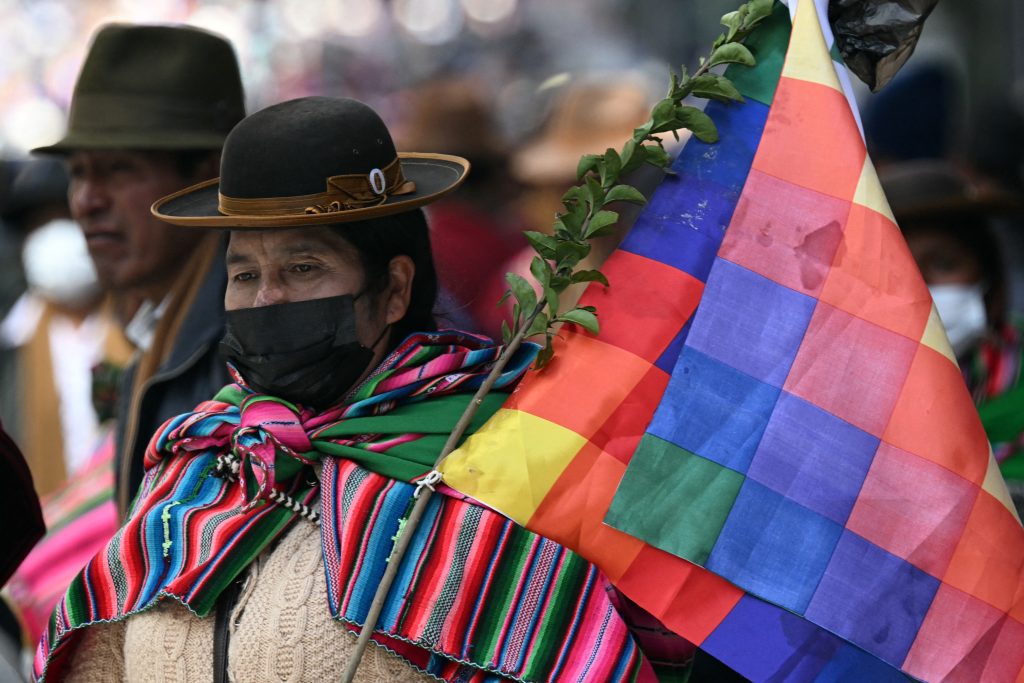
The response of the masses has been colossal. The indefinite strike decreed by the Bolivian Workers’ Central (COB), together with mobilizations from the Amazon and the relentless blockades of the Túpak Katari Peasant Trade Union Federation of La Paz, the Teachers Federations, Factory Workers and the Red Ponchos, has transformed the country into a hotbed that is not willing to give up the struggle until the fall of Paz Pereira. The mobilizations of May 18 and the following days massively dragged the masses from El Alto to surround Plaza Murillo.
Terrified by the magnitude of the revolt, Paz Pereira has tried superficial distractive maneuvers:
he hastily repealed Law 1720, sacrificed his Minister of Labor Edgar Morales after a brutal repression that has already cost the lives of five demonstrators, and called for a deceitful “Economic and Social Council,” from which the COB and the CSUTCB would be excluded. At the same time, it criminalizes the protest by issuing arrest warrants for “terrorism” against COB executive secretary, Mario Argollo, and falsely accuses the mobilization of being a mere plot financed by drug trafficking or ordered by Evo Morales. After failing to unblock it on Saturday, May 23, which claimed the life of a 21-year-old man by gunshot wound, the government has announced that it will reduce the salaries of the president and his ministers by 50%, but that did nothing to calm the fury of the mobilized bases. Currently the government and bourgeoisie are considering a State of Siege declaration, to militarize conflict zones, which will generate more mourning and blood of the working people.
But the bases have surpassed their own leadership. The “non-betrayal” pact sealed by unions and the Red Ponchos maintains a categorical mandate: no negotiations with the government until Paz Pereira resigns, meanwhile from the blockades, it has been announced that they are willing to face the state of siege. The demand of the mining and peasant bases is clear: “You either leave with a resignation or with a social upheaval.”
Who will govern after Paz? The danger of emptiness and reformism
The great strategic dilemma facing the insurrection at this turning point is the absence of an alternative power, of a revolutionary leadership capable of leading the process to the end. The wing linked to Evo Morales intends to instrumentalize the blood spilled by the working people under the Jesuit slogan of “For Life, to Save Bolivia”, seeking to channel discontent towards a reconstitution of the bourgeois legal platform that will allow him to run for president again.
The workers’ and peasants’ vanguard must understand that a return of Evo Morales, or the transitory rise of institutional figures of bourgeois replacement (such as Vice President Lara or the electoral advance), will constitute a new dead end. A new MAS government or any reformist variant will hardly modify the pace of the adjustment plans (as has been demonstrated with the “progressive” alternatives on the continent), maintaining submission of national economy to imperialism and businessmen. As Trotsky pointed out in the Theory of Permanent Revolution, in countries of backward capitalist development, the tasks of democracy and national liberation can only be solved in an integral and effective way through the dictatorship of the proletariat, for which it is necessary that the workers’ vanguard achieve the support of the peasantry, the strength and rebellion of students and the oppressed indigenous organizations that, in countries like Bolivia, they hold significant weight.
Program of action for the victory of workers, peasants and Indigenous people
To prevent the bourgeoisie from expropriating the victory of the streets again through rigged elections or parliamentary turnarounds, the COB, peasant and indigenous federations and rank-and-file committees, must immediately take up a program of class independence aimed at the seizure of power. We propose the following urgent action axis:
1. Faced with the existence of a situation of dual power – National Strike and Supply Committee: It is imperative to centralize the strike pickets, multisectoral committees and neighborhood councils of El Alto and La Paz in a large National Committee of Workers, Peasants, Students and Indigenous Delegates. This body must take control of the distribution of food, medicine and fuel directly, neutralizing the shortages caused by employer hoarding and guaranteeing the survival of hospitals and working families. In the history of great struggles in Bolivia, dual power has always been created since the irruption of the COB, and today it is necessary for the Workers’ Central and the leadership from other sectors, to once again play that leading role in order to advance the struggle process.
2. Workers’ and People’s Self-Defense: In the face of police and judicial repression by the bourgeois state, and in the face of military intervention threats backed by imperialism, the organization of workers and peasants militias is urgent. The historical experience of the Pulacayo theses must be revived: sectoral arming and structuring of unified self-defense committees under the command of the miners and Red Ponchos are required, to disarm provocateurs and dissolve the regime’s repressive forces. Call on soldiers and subordinate commanders of the armed forces and police, to stop repressing and go over to the side of the working people from which they and their families come. It is time for them to turn their arms against the government, the bourgeoisie and imperialism.
3. Workers’ Control of the Economy and Expulsion of Imperialism: No solution is viable if land and industrial property are not directly hit. It is necessary to demand the seizure of agribusiness of the East region, that speculates with the basic food basket; the immediate state obligation for exporters to repatriate 100% of dollars to the national circuit; the nationalization under workers’ control of all large-scale mining (lithium, copper, silver) and hydrocarbons; and non-payment of the usurious foreign debt.
4. No confidence in Bourgeois Dialogue or OAS traps: Reject the Economic and Social Council instituted by Paz Pereira to delay the conflict. Down with the interference of regional reactionary governments and Yankee imperialism. Immediate and unconditional release of all those arrested for fighting, and annulment of arrest warrants against union leaders!
The Bolivian working people show us the way, it is necessary to surround the struggle with solidarity through different actions in all countries, calling on unions, associations and parties to mobilize in front of embassies and consulates, discussing in each workplace and study the lesson they are giving in the streets and the necessary tasks to advance towards a great victory; likewise, we must promote boycott measures against the actions of governments supporting Paz Pereira, such as the government of Milei, who sent two C-130 planes loaded with repression materials.
Workers of Bolivia! The bourgeoisie and its agents tremble in the Government Palace. The objective conditions for the overthrow of Bolivian capitalism are ripe; what is missing is the revolutionary leadership. The task of the moment is to fuse the insurrectionary energy of the masses with the building of a genuine revolutionary and internationalist workers’ party.
Down with the starving government of Rodrigo Paz Pereira!
For a Workers’ and Peasants’ Government of rupture with the bourgeoisie and imperialism, responsible to the COB and other organs of power that emerge from mobilizations!